 Pickleball Tayo
The short answer
What is stacking in pickleball doubles?
Stacking is a doubles positioning arrangement used to reach preferred rally sides while preserving correct serving and receiving responsibilities. Agree on the sequence, rehearse it slowly, and verify the obligations for the current score and rules.
Primary reference: 2026 USA Pickleball Official Rulebook.
On this page
Stacking arranges a doubles pair so they can move toward preferred rally positions. It can help a partnership use strengths, but it adds an organizational task before the ball is even struck.
What does the visual lesson show?
Agree on the starting plan.
Talk through your positions and the next move together.
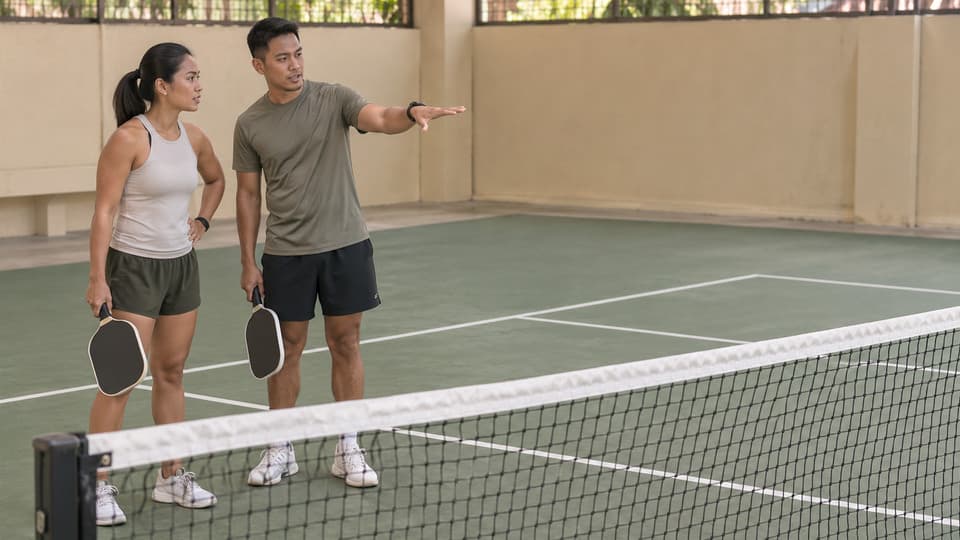
Generated illustration with authored motion. Ball flight is illustrative; the written lesson explains the decisions.
Why do pickleball partners use stacking?
A pair may prefer a forehand in the middle or a familiar left-right arrangement. Stacking is a way to reach that arrangement after the required serve or return position. It does not guarantee better coverage, and it can create confusion if players have not agreed on the switch.
How do starting responsibilities differ from rally positions?
Check the correct server, receiver, and service court using the score and the applicable rules. Then plan where each partner moves after the relevant contact. A formation is only useful if the pair can execute it without starting the rally incorrectly or crossing into one another.
How can you rehearse stacking without a competitive feed?
Walk the movement slowly and call the score at each repetition. Start with a serving-side version that both players can explain. Add a gentle return only when the responsibility is clear. If either player has to guess whose turn it is, remove the tactical layer and restore the basic sequence.
When is stacking too complex for a partnership?
Do not stack merely because a stronger pair does it. Compare the benefits with the added movement and communication cost for your partnership. In a tournament, check event rules and ask an official about uncertainty before serving. The written walkthrough offers one teaching sequence rather than every legal formation. Use the partner scene as a prompt for planning, not as a demonstration of a legal switch.
How can you apply this guide step by step?
Who must serve or receive before the switch?
Name the correct server, receiver, and service court for the score. Preferred rally sides never replace those basic obligations.
How can you rehearse the agreed movement?
Walk to the intended rally positions after the appropriate contact. Keep the route clear and make sure both partners understand who moves first.
How should you test stacking under gentle play?
Add an easy feed and a next reply only after the sequence is clear. Revert to ordinary positions if uncertainty outweighs the tactical benefit.
A hypothetical worked example
How might this work in a session?
A pair wants a preferred forehand in the middle, but one player forgets the correct receiver while concentrating on the switch. The tactical formation has created a basic error. Restore the score, server, and receiver before rehearsing movement. A slow walk-through with clear responsibilities is a better starting point than trying to copy a complicated match formation at full pace.
What are common mistakes with stacking in pickleball?
Preferred side overrides receiver
Recheck score-based responsibilities before beginning the serving sequence.
Players cross into each other
Walk the movement and simplify routes before adding speed.
Complexity copied without purpose
State the actual benefit for this pair and compare it with the added confusion.
What should you try during your next session?
Walk five score-call examples with no ball. Have both partners explain the correct start and intended finish, then add gentle rally starts to test the agreement.
What to observe: Record responsibility errors and late switches. Stacking is useful only if the partnership can execute it reliably while observing the rules.
A preferred playing side does not change who must serve or receive from the correct position.
Check your understanding
Choose an answer to see the explanation.
What should you record after trying the task?
Name one observable condition, then count a small sample. These taps record your observations; they do not detect shots or assess a rating.
Define one condition before counting.
Entries stay in this page and reset on reload. Export a text file to keep them.
What else should you know about stacking in pickleball?
What is stacking in pickleball doubles?
Stacking is a positioning arrangement that helps partners reach preferred sides after the serve or return. It does not change which player must serve or receive under the applicable rules.
Does stacking excuse an incorrect server or receiver?
No. Players must still follow the scoring, service-order, and position requirements of their format. Confirm the correct server and receiver before arranging the team’s movement.
Which sources support this guide?
- 2026 USA Pickleball Official Rulebook
Primary reference for standard-play rules and event-rule exceptions.
- USA Pickleball: Level three skills
General stroke, control, and positioning resources; not an assessment of a reader’s rating.
How was this guide prepared?
Prepared with AI assistance for human editorial review. No named coach has reviewed this draft. Examples and practice tasks are editorial explanations; no first-hand coaching or product testing is claimed.
Sources checked: . For organized play, check the current rulebook and event format. This date records source checking, not coach approval.