 Pickleball Tayo
The short answer
Where should you stand in pickleball doubles?
In pickleball doubles, position depends on the serve, return, ball location, and your partner. Move as a connected pair, cover the shared middle, and get balanced before opponents strike rather than chasing fixed spots.
Primary reference: USA Pickleball: Level three skills.
On this page
Doubles court coverage changes every time the ball moves. Two players can both be in good individual positions and still leave a large gap between them. Start by watching the pair, rather than just the person hitting.
What does the visual lesson show?
Move with your partner.
Talk through the space you cover together.
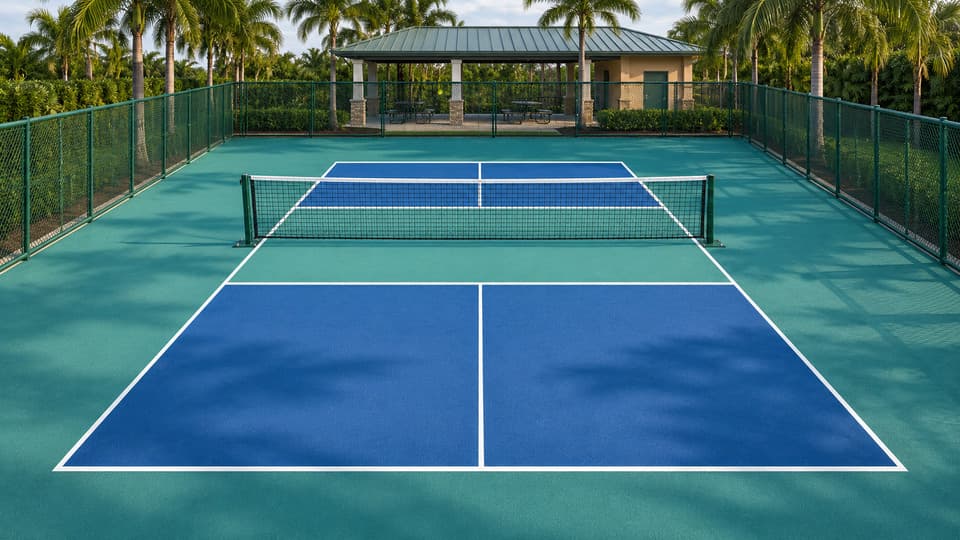
Generated illustration with authored motion. Ball flight is illustrative; the written lesson explains the decisions.
How do the serve and return affect doubles positions?
The serving pair needs to let the return bounce, so both players should be ready for depth. On the receiving side, the returner works forward after contact while the partner can begin closer to the kitchen.
These starting patterns explain why the teams often look uneven early in a rally. The next task is to arrive in a coordinated formation, rather than forcing symmetry before the return has bounced.
How should partners shift with the ball?
When the ball pulls your partner wide, move enough to help cover the middle without abandoning every other lane. Imagine a connection between you that stretches a little, rather than a rigid rope that forces identical movement.
Use the partner scene as a reminder to discuss the middle lane and the sidelines before play. It does not establish fixed standing distances. Opponent angles, reach, and your movement all change the useful spacing.
Why do large gaps between partners create problems?
If one partner advances after a weak shot while the other holds deep, opponents have space to play between or around them. Read whether your team’s shot allows both of you to move.
A short “hold” can prevent a rushed approach; an early “up” can coordinate a safe advance. Agree on the words before a match so they carry a shared meaning.
How can you review doubles positioning one rally at a time?
After a point, ask where the gap opened and which ball created it. “We were split when the third sat up” gives you a useful adjustment. “Cover everything” does not.
Try a cooperative rally where you call your movement aloud. Once the pair is comfortable, remove the extra talk and keep only the calls that help. Practise with partners of different reach and mobility rather than assuming everyone covers the same ground.
How can you apply this guide step by step?
Where is the ball-side contact likely to happen?
Notice which partner the incoming angle favors. The other player prepares coverage instead of waiting for a ball to arrive in a fixed painted half.
How can you shift as a connected pair?
Adjust depth and lateral spacing as the contact moves. Similar depth can help, but exact spacing depends on reach, speed, and the opponent’s options.
How should both partners prepare for the next strike?
Make movement useful by ending in balance. An exposed gap can come from advancing alone after a weak shot as easily as from standing too wide.
A hypothetical worked example
How might this work in a session?
Your partner is pulled wide while you stay in the original lane. The opponent sends the next ball through the gap. Chasing closer to the net would not solve that opening. Review the pair’s spacing at the wide contact, then shift enough to protect the middle while respecting the next angle. The useful unit is the partnership, not two independent positions that happened to be correct earlier.
What are common mistakes with pickleball doubles positioning?
One up, one stranded
Look at which ball triggered the uneven advance and coordinate the next move.
Both chase the same ball
Name a responsibility early and have the other partner cover the newly opened space.
Middle left uncovered
Review the pair’s lateral spacing after a wide feed, not only where each player started.
What should you try during your next session?
Use gentle feeds to alternating sides. Freeze before the feeder’s next contact and ask both partners which space they are covering. Continue only when the explanation is shared.
What to observe: Count avoidable gaps and simultaneous claims. Do not try to measure good coverage from a generated partner scene alone; actual angles and player mobility change the task.
Stay aware of your partner’s depth and the ball’s angle. Useful positioning leaves you able to help with the next shot.
Check your understanding
Choose an answer to see the explanation.
What should you record after trying the task?
Name one observable condition, then count a small sample. These taps record your observations; they do not detect shots or assess a rating.
Define one condition before counting.
Entries stay in this page and reset on reload. Export a text file to keep them.
What else should you know about pickleball doubles positioning?
Must doubles partners stand on exactly the same line?
No. Similar depth can help, but the incoming ball, coverage responsibilities, and each player’s abilities matter.
Should I always follow my return forward?
Look to gain a useful position, while getting balanced before the opponent’s contact.
Which sources support this guide?
- USA Pickleball: Level three skills
General stroke, control, and positioning resources; not an assessment of a reader’s rating.
- USA Pickleball: Third-shot drop vs. drive
Technique background for choosing between a drive and a soft drop.
How was this guide prepared?
Prepared with AI assistance for human editorial review. No named coach has reviewed this draft. Examples and practice tasks are editorial explanations; no first-hand coaching or product testing is claimed.
Sources checked: . For organized play, check the current rulebook and event format. This date records source checking, not coach approval.