 Pickleball Tayo
The short answer
Who should take the middle ball in pickleball doubles?
Agree on a default responsibility for middle balls, then adjust for the actual contact, positioning, and reach. Make an early, short call so one partner can hit while the other covers.
Primary reference: USA Pickleball: Skills and placement resources.
On this page
A middle ball can freeze a pair for a moment: both prepare, both hesitate, or both swing. “Forehand takes it” can help in some situations, but it does not solve every combination of position, handedness, and contact height.
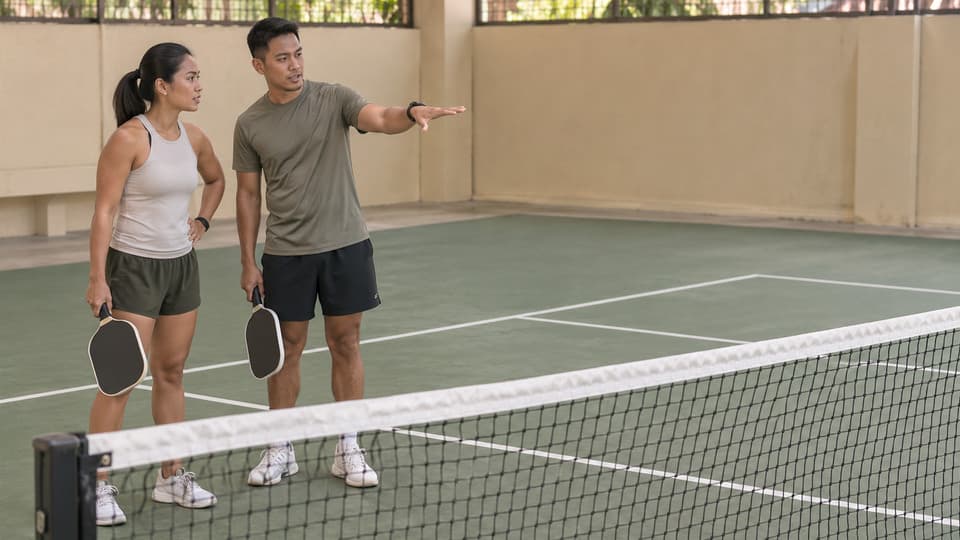
What does the visual lesson show?
Read the ball down the middle.
Agree on the shared space before the ball arrives.
Generated illustration with authored motion. Ball flight is illustrative; the written lesson explains the decisions.
How should partners agree on middle-ball responsibility?
Before a game, discuss who handles comfortable middle forehands, low backhand blocks, and balls arriving behind one partner. Two right-handed players and a left-right pair may choose different defaults.
Make the plan simple enough to remember under pressure. You are creating a starting agreement, not a legal ownership map for every ball that could land between you.
When does position matter more than forehand preference?
If your partner is balanced with the ball in front and you are reaching across your body, their backhand may be the cleaner option. A favorite forehand does not automatically justify crowding that contact.
Watch the incoming angle. A ball traveling through the middle can favor one player long before it crosses the centerline. Recognizing that angle early leaves more time to communicate.
What should you call before taking a middle ball?
Use a short call such as “mine” or “yours” when it can still help. Once your partner has clearly claimed a reachable ball, prepare to cover the next space instead of taking a second swing beside them.
If a call was late, discuss the timing between points. Repeating louder instructions during contact can distract rather than clarify. Keep the conversation about the next adjustment.
How can you practise middle-ball decisions with a partner?
Stand in your usual formation and ask a feeder to send gentle balls between you. Call the hitter before the bounce when possible. Stop any feed where both would swing into the same area.
After a short set, change the feed angle and swap positions. Record which situations caused hesitation. Your next game needs only one or two clearer agreements, rather than a complicated system neither partner can recall.
How can you apply this guide step by step?
What middle-ball default can both partners explain?
Discuss comfortable middle contacts before the game, including handedness and backhand blocks. Keep the first agreement simple enough that both players can remember it.
Who has the more manageable actual contact?
Check who is balanced and who would need to lunge. Position and angle can favor the partner whose preferred stroke is not the nominal default.
How can one partner call while the other covers?
Make one short claim while the other player can still respond. After yielding, prepare the next gap rather than taking a late second swing.
A hypothetical worked example
How might this work in a session?
Two right-handed partners agree that a comfortable forehand takes the middle. During a rally, the forehand player is stretched wide while the partner has a balanced backhand in front. Applying the slogan without reading position creates a collision risk and a worse contact. Keep the default, but let a timely call and the available contact override it. The agreement should simplify decisions rather than forbid sensible exceptions.
What are common mistakes with middle balls in pickleball doubles?
Both players hesitate
Rehearse gentle middle feeds with an explicit starting responsibility and earlier calls.
Forehand player crowds every ball
Compare balance and reach rather than treating stroke preference as ownership.
Calls arrive during contact
Simplify the words and practise recognizing the favored player before the bounce.
What should you try during your next session?
Try ten gentle middle feeds from two angles. Count clear early claims and hesitation events. Stop a feed where both players would swing in the same space; restart it cooperatively.
What to observe: Ask whether the call changed the partner’s action in time. Loudness is less informative than whether one clean contact and useful coverage followed.
Agree on a default responsibility, then let the player with the earlier, more balanced contact call clearly.
Check your understanding
Choose an answer to see the explanation.
What should you record after trying the task?
Name one observable condition, then count a small sample. These taps record your observations; they do not detect shots or assess a rating.
Define one condition before counting.
Entries stay in this page and reset on reload. Export a text file to keep them.
What else should you know about middle balls in pickleball doubles?
Does the centerline decide who owns the ball in a rally?
No. It is not a doubles ownership boundary. Position, angle, and your agreement guide the choice.
What if both of us keep hesitating?
Simplify the default, practise gentle feeds, and work on making the call earlier.
Which sources support this guide?
- USA Pickleball: Skills and placement resources
General skills and placement resources; partner responsibilities require an agreed team plan.
- USA Pickleball: Sportsmanship guide
Conduct, fair rotation, and line-call guidance; official rules take precedence.
How was this guide prepared?
Prepared with AI assistance for human editorial review. No named coach has reviewed this draft. Examples and practice tasks are editorial explanations; no first-hand coaching or product testing is claimed.
Sources checked: . For organized play, check the current rulebook and event format. This date records source checking, not coach approval.